
Wikimedia Commons
Overview
Barcelona, in northern Spain, is bounded by mountains, rivers, and the Mediterranean Sea. Its long and complicated history and enduring architectural creativity can be presented as a progressive evolution, in discrete districts - expanding from the Roman port, Bàrcino; through the mediaeval capital of Aragonese maritime territories; the C18th colonial citadel built by the victorious Castilian administration; the C19th planned L’Eixample; the C20th Modernist Passeige de Gracia; and the 1990s Olympic port at Barceloneta. Barcelona’s people and designers have long been aware of the scenographic and political potential of the sites and architecture they commission and design: the distinction between the ‘authentic’ and the ‘simulacrum’ is repeatedly blurred. The tour uncovers something of this complex relationship to architecture.
-
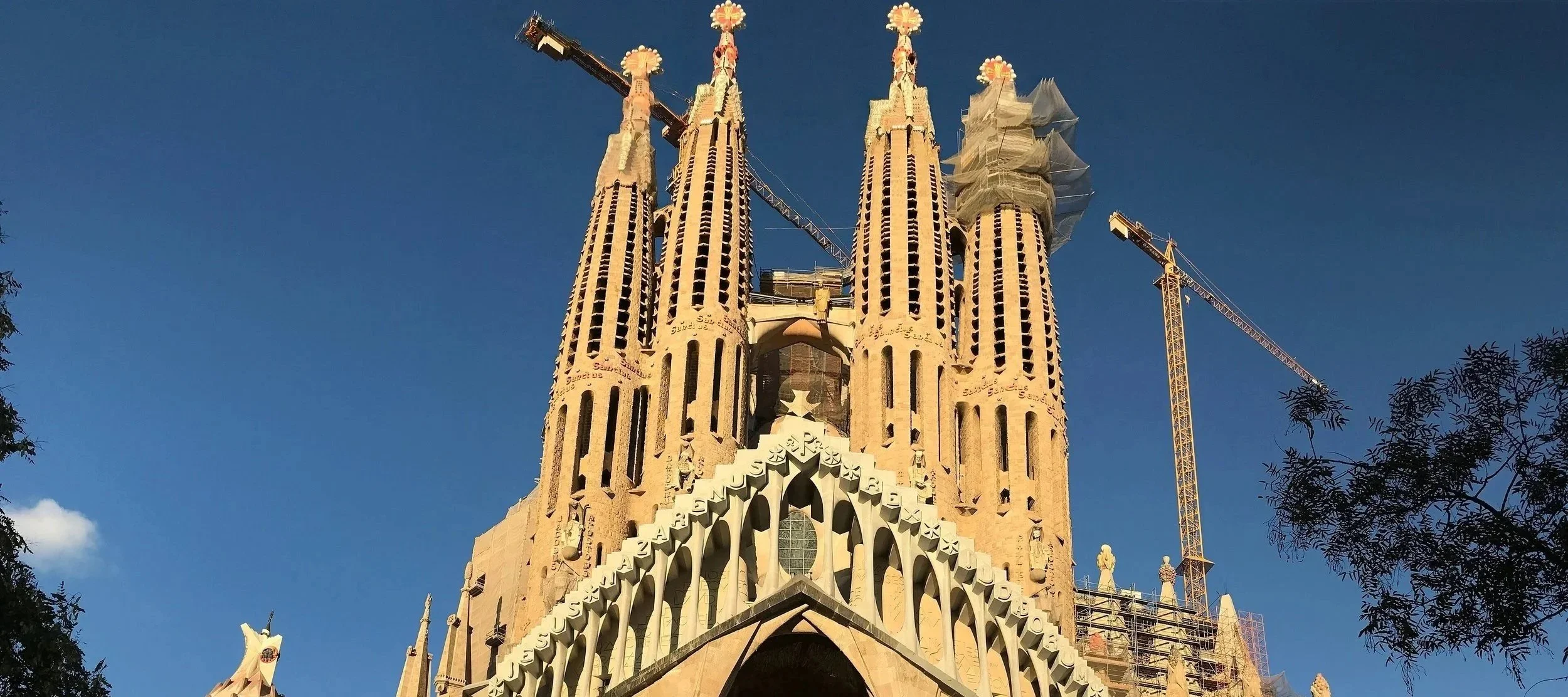
Barcelona has been designated 2026 UNESCO-UIA World Capital of Architecture, acknowledging the anniversary of one of the city’s most famous buildings: the Basílica i Temple Expiatori de la Sagrada Família, designed principally by Antoni Gaudí and under construction since 1882. The completion of the basilica’s prominent towers is scheduled to coincide with the centenary of Gaudí’s death. Designated God’s Architect by many, Gaudí devoted his final years to the basilica, living a life of penurious austerity dedicated to his chef-d'œuvre. After his death, in a road accident on 10 June 1926, he remained unidentified for days as he was believed to be a beggar. On 14 April 2025, the late Pope Francis declared Gaudí as Venerable and Pope Leo XIV will visit in June on the centenary of Gaudi’s death. Though the structure remains incomplete, the armature supporting the final spire - of 18 - was secured on 31 October 2025, rendering the Sagrada Família the world’s tallest church. Professor Guillem López Casasnovas, Trustee of the Basilica, will introduce us to the basilica and some of those working on it. This forms the centrepiece of the tour.
Informed by British and Iberian scholars, the tour commences with a drinks reception in the Pavelló Mies Van der Rohe, built as Germany’s contribution to the 1929 Exhibition and often called the ‘Barcelona Pavilion’. It has become emblematic of Barcelona for sure, but in Barcelona we are often not sure what we are looking at.
Tour Highlights
Pavelló Mies Van der Rohe: Drinks reception and private tour
La Basilica de La Sagrada Familia: Welcome from Trustee, Prof Guillem Lopez Casasnovas; discussion with craftspeople working on the basilica and visit to new architectural exhibit
Architectural drawings at the Historical Archive of the College of Architects of Catalunya
Walking tour of the Gothic Quarter in the steps of C19 architect G.E. Street including the Catedral de la Santa Creu i Santa Eulàlia (La Seu), and Santa Maria del Mar and the Llotja Aragonese Exchange
Visits to key sites related to the 1992 Olympic Games
Private tours of the Parc de Recerca Biomèdica (2006) and Hospital del Mar (2017)
Dinner by the Mediterranean Sea
Provisional Itinerary
-
17.30: Congregate and walk from Teatre Lliure to Pavelló Mies Van der Rohe
18:00- 20:00: Welcome from Neil Jackson and Carolina B. Garcia-Estévez; private introduction and view; drinks and tapas.
-
Antoni Gaudí - God’s Architect
La Basilica de La Sagrada Familia:
Introduction by trustee Prof Guillem Lopez Casasnovas; English-speaking guide, discussion with craftspeople; view new architectural exhibit.
Lunch en route to
Hospital de la Santa Creu i Sant Pau
Palau Guell
Dinner: Guests may wish to visit the Palau de la Música Catalana to enjoy a concert/dine at their own expense
-
Morning: La Barceloneta and contemporary architecture:
Torre Mapfre (1992)
Hotel Arts (1992, 1994)
El Peix d'Or (1992)
Parc de Recerca Biomèdica (2006)
Hospital del Mar Pinearq + Brullet de Luna (2017)
Mercat de la Barceloneta (2007)
Refreshments: Nova Icària Beach promenade
Olympic Marina (1992), renovated (2014)
Olympic Village (1992)
Lunch at Santa Caterina Market (1845, 2005)
Afternoon: Ciutat Vella
The Gothic Quarter in the steps of G.E. Street.
Historical Archive
Catedral de la Santa Creu i Santa Eulàlia
Carrer del Bisbe
Santa Maria del Pi
La Llotja Aragonese Exchange
Santa Maria del Mar
Free evening
-
Morning: Monjuic
Montjuïc Anella Olímpica (1929)
Estadi Olímpic (1992).
Torre Calatrava (1992)
Piscines Bernat Picornell (1992)
Fundacio Joan Miro Exterior only
Lunch at cafe
Afternoon: El Raval
Teatre Lliure
Las Arenas de Barcelona
Antic Hospital de la Santa Creu
Monestir de Sant Pau del Camp
Museu d’Art Contemporani de Barcelona (Richard Meier)
Evening: Tour Dinner
Drinks: Red Fish Bar
Dinner: Agua
Member Rate: £650
Non-member Rate: £800
(Both rates include a city travel card, select refreshments, a special tour dinner, and a fundraising donation. They exclude travel and accommodation).