
The 2025 Annual Awards Ceremony
We are pleased to congratulate the winners of this year’s Society of Architectural Historians of Great Britain awards.
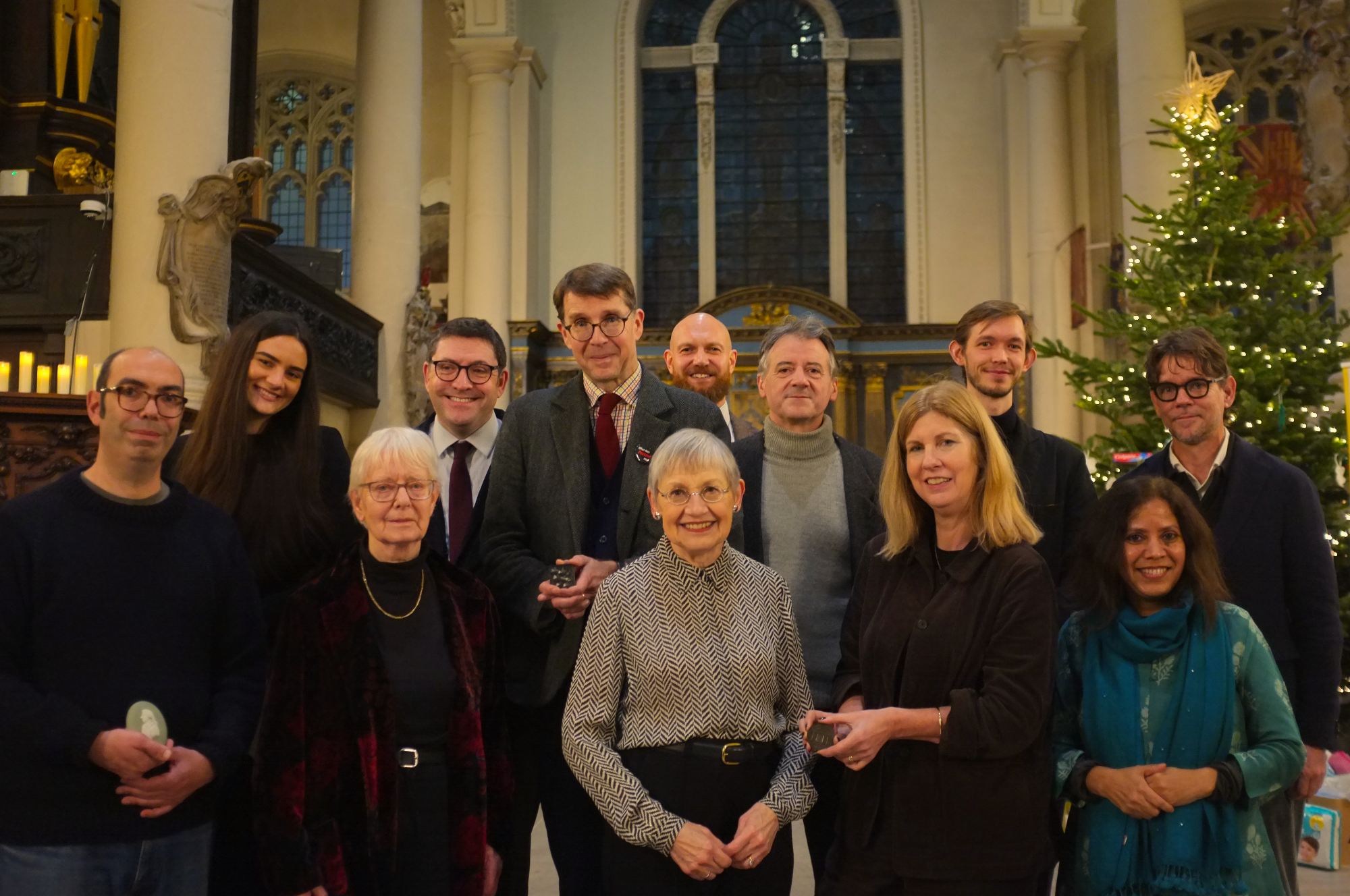
Alice Davis Hitchcock Medallion
Awarded annually since 1959 to a monograph that makes an outstanding contribution to the study or knowledge of architectural history.
Judges: Prof. Gary Bord, Prof. Hilary Grainger, Dr Zoe Opacic, Prof. Florian Urban, Dr Patrick Zamarian
Chair: Prof. Elizabeth McKellar, SAHGB President
Winner:
André Tavares, Architecture Follows Fish: An Amphibious History of the North Atlantic (The MIT Press)
This groundbreaking book explores the relationship between architecture and ecology. In it Tavares traces the ways in which the harvesting, processing and selling of fish has shaped architecture in the North Atlantic. The book ranges widely geographical and chronologically from the colonial fishing and whaling grounds of Newfoundland and America to the Atlantic coasts of Scandinavia and Portugal and then down through the North Sea to Billingsgate Market. It concludes with the impact of refrigeration and industrialisation on the marine environment. Tavares argues that it is not just fishing, but also the characteristics of the different types of fish themselves, which have shaped human’s interactions with the piscatorial. In so doing Tavares extends the boundaries of architectural history to embrace the maritime and the terrestrial together in one overarching and highly original account.
The Colvin Prize
Awarded annually to the author or authors of an outstanding work of reference of use and value to architectural historians and the discipline of architectural history across a range of formats.
Judges: Sarah Akigbogun, Helen Iball, Dr Kate Jordan, Prof. Adam Sharr, Dr Matthew Wells
Chair: Dr Alistair Fair
Commendation:
Dana Arnold, Women and Architectural History: The Monstrous Regiment Then and Now (Routledge)
The judges would like to offer a commendation to Women and Architectural History: The Monstrous Regiment Then and Now, edited by Dana Arnold (Abingdon, Routledge, 2025). Its essays by female historians on their work and approaches reflect on what architectural history can and should be, and form a significant work of reference as well as a valuable teaching resource.
Winner:
Tania Sengupta and Stuart King, Reclaiming Colonial Architecture (RIBA Publishing)
From a strong shortlist, the SAHGB Colvin Prize is awarded to Reclaiming Colonial Architecture, edited by Tania Sengupta and Stuart King and featuring essays by 45 authors. The judges admired the geographic range of the work, the intellectual rigour and ambition of the contributions, the ways in which original and sophisticated arguments were presented clearly and engagingly, and the very high production values. Though diffuse in approaches and topics, the book stands well as a whole and serves as a key work of reference that sets out the latest thinking in this area. This work will clearly have broad appeal, not only among academic historians but also students, those working in practice and the wider public.
Hawksmoor Essay Medal
To encourage new and unpublished entrants to the field of architectural history, the Society's Essay Medal (popularly known as 'the Hawksmoor') is awarded annually to the author of the best essay submitted in competition.
Judges: Dr Doreen Bernath, Prof. Zeynep Kezer, Dr Emily Mann
Chair: Dr Elizabeth Darling
Commendation:
Tom Joashi: Staging a Tragedy: On the Refurbishment of the Louvre and the St. Bartholomew’s Day Massacre (1572)
The judges commended this work for its inventive methodology and its eloquent and sophisticated prose. Making extensive use of primary sources, it applies an interpretative framework more commonly used to understand 21st -century events to an early modern environment. It offers a close reading of space at multiple levels, one situated firmly within a period eye and presents a nuanced and rigorous reading of the available material, with careful interpretation of the different types of evidence and the gaps it may contain.
Winner:
Nicholas Forrest Frayne: Nyayo House as a Political Tool: The Politics of Temporal Control
The essay is an analysis of the legacy of the Nyayo House in post-colonial Nairobi. An apparently ordinary office building– a passport office - it was in fact used for the torture of dissidents. The judges felt that this was an important and timely piece of writing, which demonstrated the necessity and relevance of spatial analysis for explicating how political power operates on the ground. In doing so the essay offered a highly-skilled synthesis of primary and theoretical sources, with excellent use of in-depth first-hand research. From that synthesis, the building emerges as a physical manifestation of the banality of evil—the mundane, run-of-the mill office building inconspicuously nestled in the city juxtaposing the state’s provision of citizen services with torture. The range and scope of the paper was also agreed to be especially impactful on debates about difficult heritage.
Heritage Research
The SAHGB-IHBC Heritage Research Award recognises and celebrates the quality of architectural-historical research produced by colleagues in heritage and conservation practice, as private consultants and in non-departmental public bodies.
Judges: Neil Burton, Simon Green, Liz Green, Joanna Smith
Chair: John Cattell FSA IHBC
Commendation:
Dr Michael Dring, Continuity in the Modernist City: The Heritage Activism of Save Smallbrook, Birmingham (Birmingham City University)
The judges were impressed with this clearly written and passionate research submission focusing on James Roberts’s Brutalist late 1950s Smallbrook Ringway Centre adjoining the inner ring road in central Birmingham. Architectural analysis of the landmark complex in its inner-city context is put forward alongside a counter-proposal for its sustainable future with an emphasis on retention rather than demolition and reconstruction. Although a decision has been made to demolish the complex, the campaign provides a blueprint for collaborative action and public involvement in advocating for key aspects of 20th-century heritage.
Winner:
Dr Victoria Perry and Isabelle Adamthwaite (Donald Insall Associates), Georgetown, Guyana (Excerpt from Georgetown Conservation Area Management Plan 2025)
The winner of this year’s Heritage Research Award is a team from Donald Insall Associates for their research on the historical development and architectural history of Georgetown, Guyana. The research, drawing on primary and secondary sources, was carried out in collaboration with a team from the University of Guyana and involved a field visit and consultation with local stakeholders. The judges were impressed with the clear and succinct analysis of the development and wider character of the Kingston and Cummingsburg areas of Georgetown. Beautifully written and illustrated, the research and the approach will not only inform masterplanning in Georgetown, but also, potentially, in other former colonial contexts. Complex issues associated with the area’s colonial and post-colonial past, and of contested heritage, are handled with sensitivity and insight.
The Dissertation Prizes
This prize celebrates the outstanding work in architectural history being carried out by postgraduate students on taught Masters-level courses in UK universities. The prize awards innovative and critical thinking in and around the subject of Architectural History, broadly conceived, which supports the Society’s aim to help create ‘a bigger discipline’.
To acknowledge the differences in the educational and pedagogical structures at different courses, the Society has two distinct categories for the Dissertation Prize.
Category 1: For dissertations by students on taught Masters-level courses related to architectural history and heritage
Judges: Dr Ewan Harrison, Dr Anne Hultzsch, Dr Robert Proctor
Chair: Dr Moa Carlsson
Category 1 Winner:
Zaina Abou Seif, Between Earth and Ink: Vernacular, Memory, and Utopia in Hassan Fathy’s Architectural Visualisations
Between Earth and Ink: Vernacular, Memory, and Utopia in Hassan Fathy’s Architectural Visualisations is an ambitious MA dissertation, using new research on a rich body of published and unpublished primary sources to develop a highly novel reading of several of Fathy’s paintings. The work makes a significant contribution to the history of this important architect, illuminating a previously understudied facet of his work with an approach strongly grounded in relevant post-colonial theory. This accomplished dissertation makes a clear and salient argument about the role of paintings and other forms of architectural representation in Fathy's oeuvre, with wider implications for the historical study of architectural practice more generally. It calls for the study of affective structures and emotional resonances within architecture and its multiple modes of representation, and successfully demonstrates a way to implement this. Well-structured and written in succinct and engaging prose, the dissertation includes a judicious use of images to further its argument. Overall, Between Earth and Ink stood out for the judges as the clear winner among this year’s MA submissions in terms of its originality as well as its significance for both the history of 20th-century Egyptian architecture and the discipline at large. The author of the dissertation is Zaina Abou Seif, a student in the MA: Architectural History programme at the Bartlett School of Architecture, UCL. The dissertation was supervised by Professor Tania Sengupta.
Category 2: For dissertations by taught Masters-level students on accredited professional architecture (MArch) degrees
Judges: Richard Adetokunbo Aina, Dr Ruth Lang, Dr Lui (Radium) Tam
Chair: Dr Moa Carlsson
Category 2 Commendation:
Io Grivea, Ethnography of the Middle: Tracing the Visible and Invisible Bureaucratic Curators of Athens’ Modern Heritage
Ethnography of the Middle is a thought-provoking and original dissertation which addresses the politics of heritage in the context of Athens, Greece. Offering storytelling as an alternative approach to architectural heritage, the dissertation engages with non-aesthetic analysis in the context of heritage conservation, exploring Athens’s modern monuments as both complex “designs of destruction” and “designs of bureaucracy”. The dissertation deftly outlines the “messy” process and craft of research, offering a sense of gravitas to the aspects of historiography, which are so often unseen or deliberately erased. By framing “the middle” --- an often-overlooked analytical category --- as a social and spatial condition champions the reconsideration of architectural history as a lived and socially embedded practice rather than a material field. Its engagement with ethnographic research methods offers an unusual and productive lens that stood out to the judges for paving the way for the work of future architectural historians. The Runner-Up for this year’s MArch Dissertation Prize is Io Grivea, a student in the Master of Architecture (MArch) programme at the Bartlett School of Architecture, UCL, where they were supervised by Professor Tania Sengupta.
Category 2 Winner:
Alexandra-Clara Popescu, Memory as an Act of Spatial (Re)production
The intellectual reach and thematic boldness of Memory as an Act of Spatial (Re)production offers a sophisticated and well-articulated reading of memory studies, erasure, political history and spatial reconstruction in Bucharest, Romania. This dissertation demonstrates how archival materials can serve as a framework for architectural reconstruction in contexts of radical erasure, and argues that the built environment itself constitutes a living archive that can counteract state-imposed collective amnesia. A particular strength of the dissertation is its strong theoretical grounding, which is creatively applied through multimodal research. The deeply ambitious study draws on a varied range of primary sources and primary research conducted in Romania, utilising oral history and visual source material, to reconstruct the now razed Uranus neighbourhood as a territory for research. In the words of the author: “Although the physical space has changed, the memory of the erased spaces remains intertwined with the present landscape, the lost city persisting within the existing one.” By synthesising theories from urban studies, memory studies, and architectural theory, Memory as an Act of Spatial (Re)production offers new perspectives on the relationship between memory, identity, and urban space in post-traumatic urban contexts. The winner of this year’s MArch Dissertation Prize is Alexandra-Clara Popescu, a student in the Master of Architecture (MArch) programme at the University of Westminster, where they were supervised by Dr Mirna Pedalo.
About SAHGB
The Society of Architectural Historians of Great Britain brings together all those with an interest in the history of the built environment – academics, architects, heritage experts and the wider public. As the leading body in the field, we believe that appreciation of architectural history plays a vital role in understanding our culture, past and present. With the help of our members, we publish new research, organise a broad range of events, provide educational opportunities and advance the understanding of the built histories of all periods and places, in Britain and beyond.
The awards are overseen by the SAHGB to reward work that is innovative, ambitious and rigorous in tackling histories of the built environment as broadly conceived. The SAHGB’s awards programme is open and inclusive wherever possible, celebrating diversity of approach and recognising work at all career levels.
Please contact the SAHGB at info@sahgb.org.uk for further information.